A practical guide to Digital Product Passports, EU regulations, upcoming requirements and the data challenges businesses should prepare for.
What Is a Digital Product Passport (DPP)?
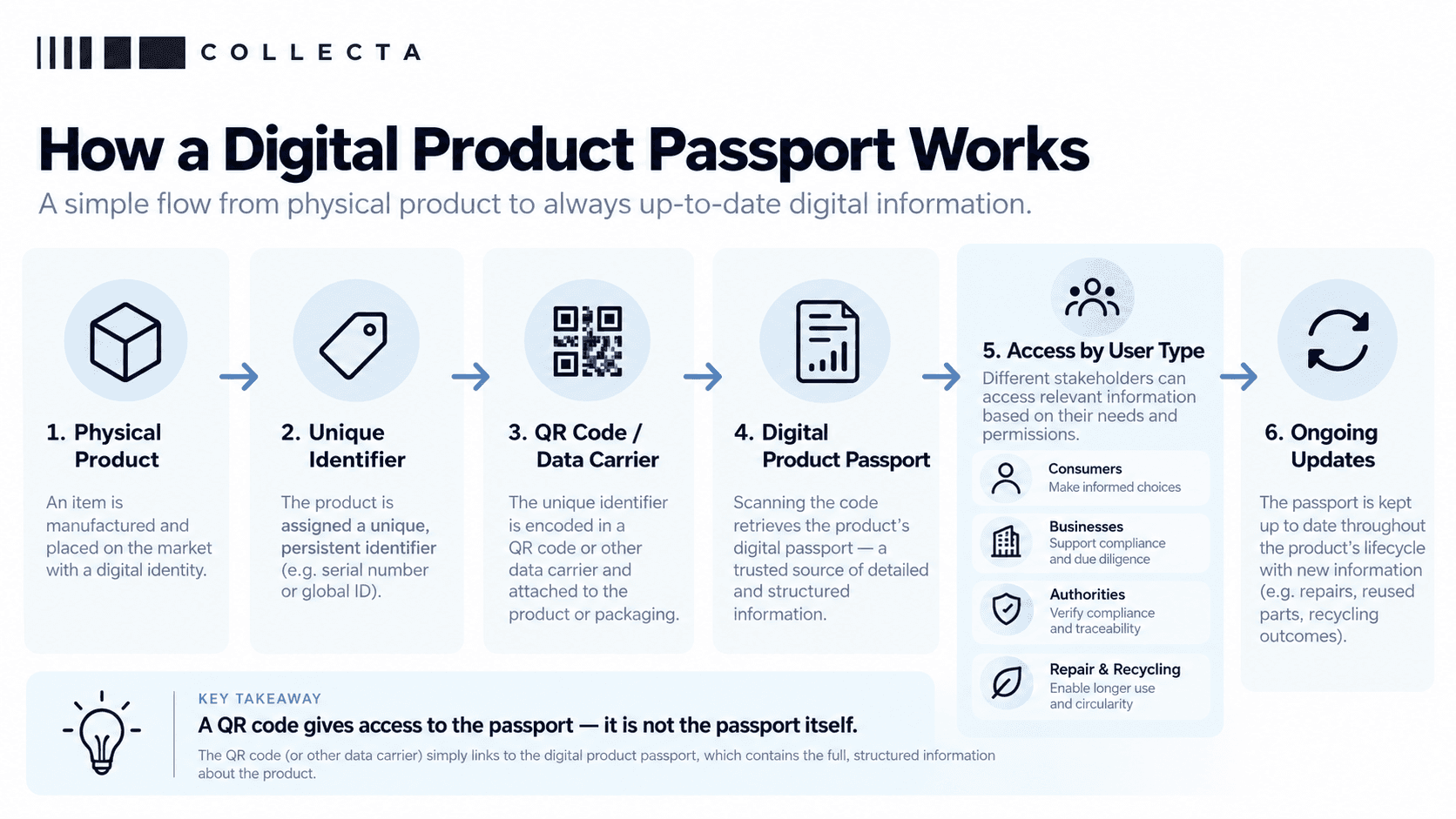
A Digital Product Passport (DPP) is a structured digital record that provides access to relevant information about a product, its characteristics and its lifecycle. Connected to a physical product through a data carrier such as a QR code, it enables consumers, businesses, authorities and other authorised stakeholders to access information according to their rights.
The European Union is introducing DPP requirements progressively through the Ecodesign for Sustainable Products Regulation (ESPR) and other sector-specific legislation.
However, not every product needs a DPP today, and there is no single compliance deadline for all industries.
Digital Product Passport: At a Glance
- What is it? A structured digital record containing relevant product information.
- How is it accessed? Through a data carrier, such as a QR code, connected to a unique product identifier.
- Who uses it? Consumers, manufacturers, suppliers, repairers, recyclers and public authorities, depending on their access rights.
- Is it mandatory? For certain product groups, under applicable legislation.
- When does it apply? Requirements are introduced progressively, with different timelines for different products.
- What should businesses prepare? Product data, supplier information, responsibilities and processes for maintaining accurate records.
In short: A Digital Product Passport is not just a QR code. It is a system for making relevant product information accessible, structured and maintainable throughout the period required by law.
How Does a Digital Product Passport Work?
A Digital Product Passport connects a physical product to its digital information.
Although technical requirements vary by product category, the process generally includes five steps.
1. Product information is collected
The responsible business gathers the information required under applicable legislation.
Data may come from manufacturing records, technical documentation, enterprise systems, suppliers and other sources.
2. A unique product identifier is assigned
The product is linked to an identifier that allows the relevant digital record to be found.
Under the ESPR framework, product-specific rules determine whether passports operate at model, batch or individual-item level.
3. A data carrier connects the physical product to the passport
A QR code is one familiar example.
Scanning the code enables the user to access the corresponding digital information.
4. Information is made available according to access rights
Not all information is necessarily public.
Consumers, authorities, repairers and other authorised stakeholders may have access to different information.
5. Information is maintained as required
The responsible parties must ensure that passport information remains accurate and accessible in accordance with applicable legislation.
The passport therefore needs more than a digital interface. It needs reliable data sources, defined responsibilities and processes for managing changes.
Why Is the EU Introducing Digital Product Passports?
The EU is introducing Digital Product Passports to support more sustainable products, resource efficiency, transparency and the circular economy.
Product information is often distributed across multiple organisations and systems.
A manufacturer may hold the product specifications. A raw material supplier may hold composition information. A subcontractor may maintain production records. Repair and recycling information may exist elsewhere.
When these systems are disconnected, accessing reliable information can become difficult.
Digital Product Passports aim to improve information accessibility and interoperability throughout relevant product lifecycles.
Potential benefits include:
- Supply-chain transparency: Making relevant product information easier to find and share.
- Repair and reuse: Supporting access to maintenance, component and repair information.
- Recycling: Improving the availability of relevant material and end-of-life information.
- Regulatory oversight: Helping competent authorities access required compliance data.
- Better-informed decisions: Providing consumers and businesses with more reliable product information.
A DPP does not automatically guarantee that a product is sustainable or compliant.
It provides the infrastructure for sharing information. The underlying data must still be accurate and supported by appropriate evidence.
Which EU Regulations Introduce Digital Product Passports?
Digital Product Passports are being introduced through different EU legal frameworks.
Two particularly important examples are the ESPR and the EU Batteries Regulation.
Ecodesign for Sustainable Products Regulation (ESPR)
Regulation (EU) 2024/1781 establishes the overarching framework for ecodesign requirements and Digital Product Passports for relevant product groups.
The ESPR entered into force in July 2024.
However, its entry into force did not make DPPs immediately mandatory for every product.
Instead, the European Commission develops product-specific requirements through delegated acts.
These rules determine:
- Which products are covered.
- Whether a DPP is required.
- Which information must be included.
- Whether the passport operates at model, batch or item level.
- Who can access or update specific information.
- When the requirements become applicable.
A product group's inclusion in the ESPR Working Plan does not automatically mean a DPP will be mandatory for that group.
EU Batteries Regulation
Regulation (EU) 2023/1542 establishes a specific Battery Passport requirement.
From 18 February 2027, relevant batteries placed on the EU market or put into service must have a Battery Passport.
The requirement covers:
- Electric vehicle (EV) batteries.
- Light means of transport (LMT) batteries.
- Industrial batteries with a capacity greater than 2 kWh.
The Battery Passport combines information about the battery model with information specific to the individual battery.
For companies working with these battery categories, the preparation timeline is therefore more immediate than for many sectors still awaiting product-specific ESPR rules.
Further reading: What Is an EU Battery Passport? Requirements and Responsibilities
Which Products Need a Digital Product Passport — and When?
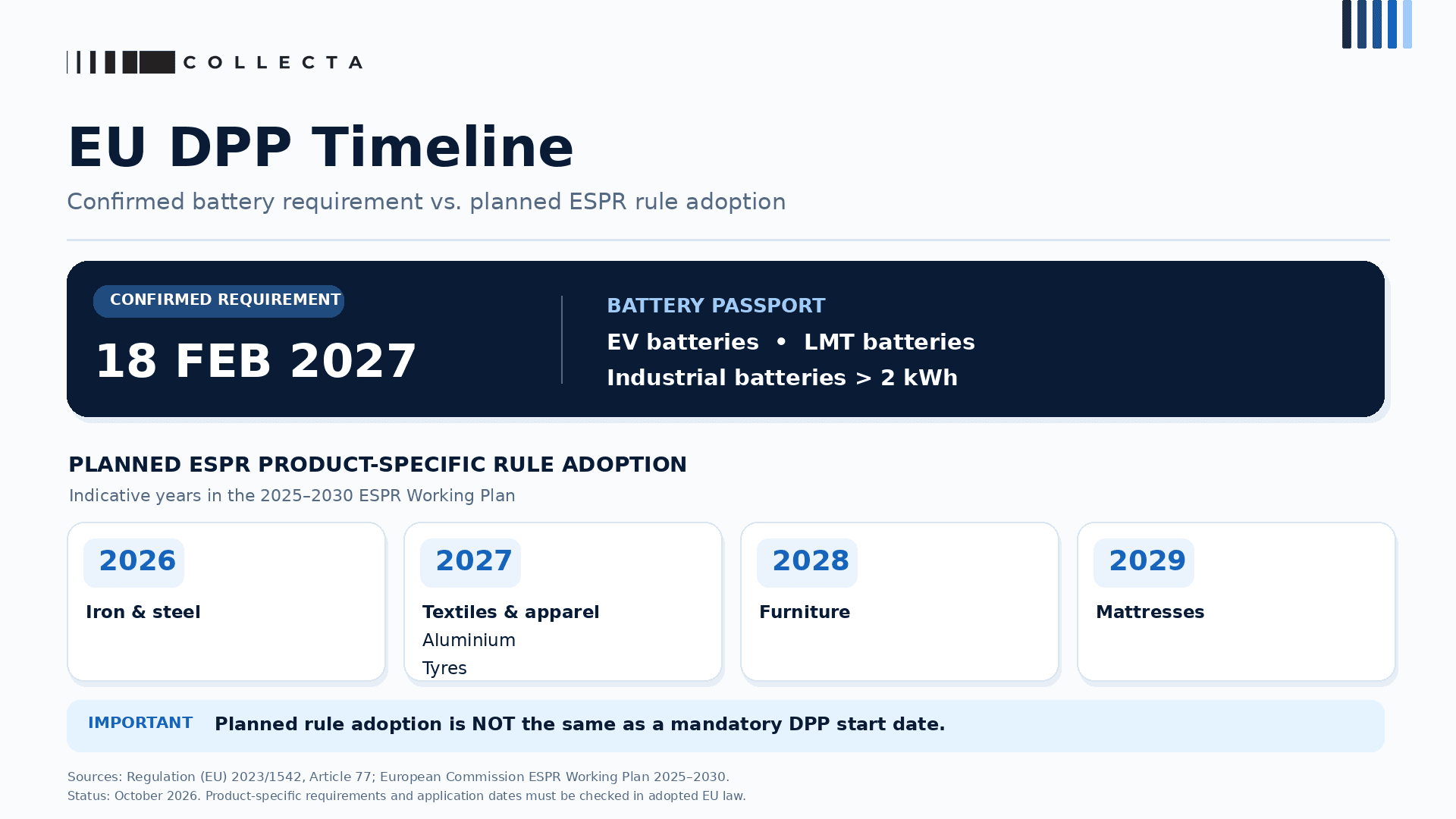
There is no universal date when Digital Product Passports become mandatory for all products in the European Union.
The European Commission is introducing requirements progressively.
It is essential to distinguish between a confirmed legal obligation and a planned date for adopting product-specific legislation.
EU Digital Product Passport Timeline: Confirmed vs Planned
| Product group | Date or target | Status | What the date means |
|---|---|---|---|
| EV, LMT and industrial batteries greater than 2 kWh | 18 February 2027 | Confirmed obligation | Battery Passport requirement under Article 77 of Regulation (EU) 2023/1542 |
| Iron and steel | 2026 | Planned rule adoption | Target for an ESPR product-specific delegated act |
| Textiles, aluminium and tyres | 2027 | Planned rule adoption | Target for product-specific legislation, not an automatic DPP compliance date |
| Furniture | 2028 | Planned rule adoption | Target for a product-specific delegated act |
| Mattresses and ICT products | 2029 | Planned rule adoption | Indicative working-plan target |
| Selected energy-related products | 2026–2029 | Product-specific work | Different regulatory measures and timelines |
Source: European Commission Digital Product Passport implementation timeline and ESPR Working Plan. Status reviewed on 20 October 2026.
For the ESPR product groups, these years represent indicative targets for regulatory work or adoption, not necessarily the dates when products must carry passports.
The European Commission indicates that economic operators generally receive a transition period of at least 18 months following the adoption of the relevant ESPR delegated act.
The final obligations will depend on the applicable product-specific legislation.
This distinction is particularly important when businesses are making investment decisions or communicating upcoming requirements to their suppliers.
What Information Does a Digital Product Passport Contain?
The information included in a DPP depends on the applicable product-specific legislation.
Depending on the product category, required information may concern:
- Product identification: Unique identifiers, manufacturer details, product descriptions and relevant model or batch information.
- Materials and composition: Information about materials, substances or components where required.
- Technical characteristics: Relevant product performance, safety, durability and technical specifications.
- Environmental information: Applicable carbon footprint, recycled content, resource-efficiency or other sustainability-related information.
- Repair and end-of-life information: Maintenance, spare parts, repairability, disassembly and recycling information where applicable.
- Compliance documentation: Required declarations, certificates or other documentation specified by the relevant legislation.
Not all these data categories apply to every product.
The specific requirements, access rights and level of detail must be established by the applicable rules.
Does every DPP need an individual product identifier?
A DPP requires the appropriate product identification, but the required passport granularity is not identical across all sectors.
Under the ESPR, the applicable delegated act determines whether a passport is established at model, batch or individual-item level.
The Battery Passport has its own sector-specific requirements concerning individual batteries.
Businesses should therefore avoid assuming that every DPP operates at the same level.
What Is the EU Digital Product Passport Registry?
The EU Digital Product Passport Registry is the European Commission's central registration and indexing infrastructure.
The Registry became operational on 20 July 2026.
It stores the identifiers and registration information required under applicable legislation.
However, the Registry is not intended to host the complete dataset of every Digital Product Passport.
Detailed passport information is stored in a decentralised manner by the responsible economic operator or an appropriate DPP service provider.
This creates an important distinction:
The EU DPP Registry supports registration and identification.
The DPP platform manages and makes available the detailed product information.
Companies preparing for DPP requirements should consider both functions when designing their infrastructure.
Product-specific technical and registration requirements continue to evolve. The availability of the central Registry does not necessarily mean every sector-specific workflow is fully available.
What Does a Digital Product Passport Look Like? Three Examples
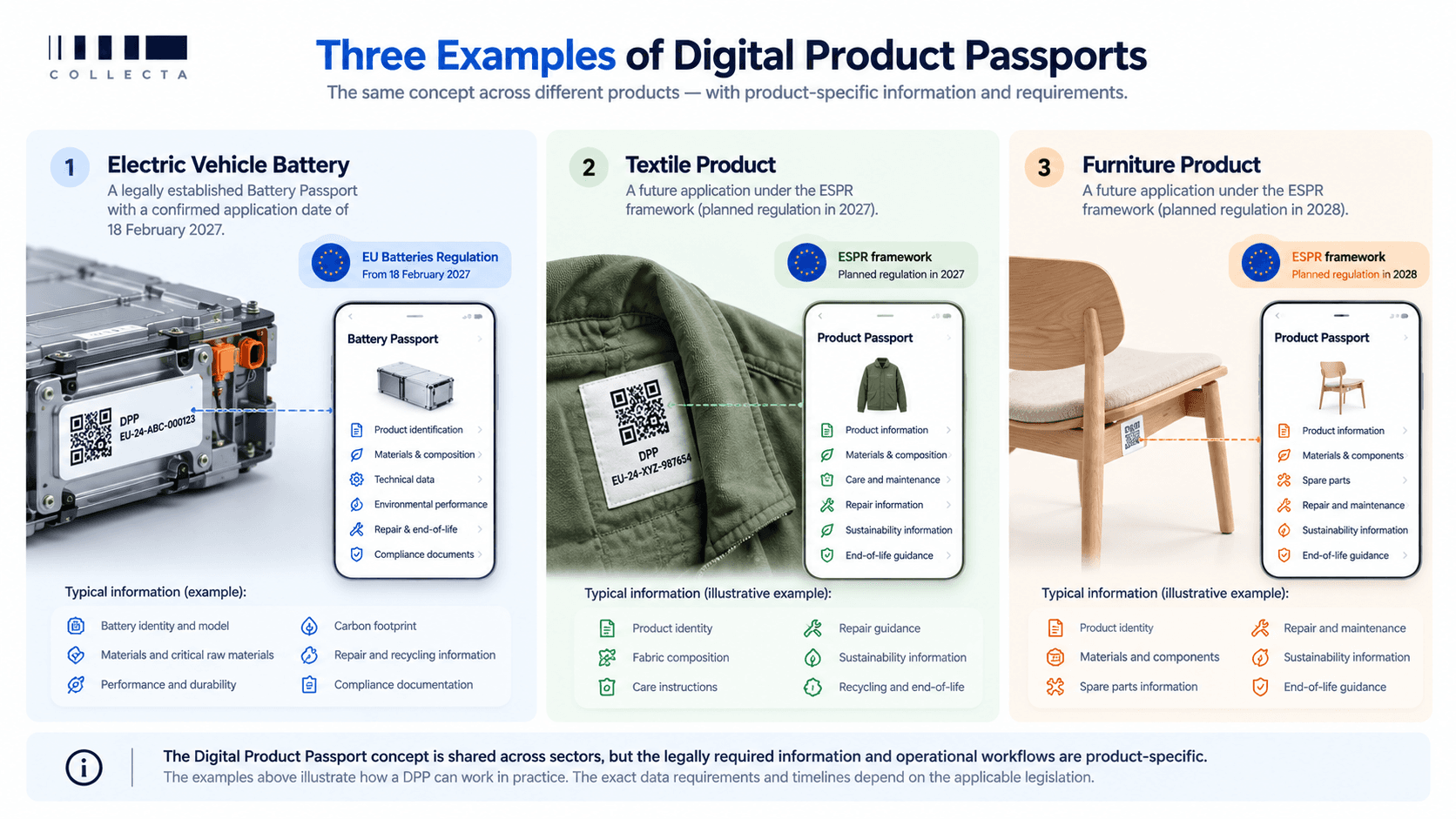
Digital Product Passports may serve different purposes depending on the product.
The following examples include one legally established use case and two illustrative scenarios for future product groups.
Example 1: Electric Vehicle Battery Passport
An electric vehicle battery is connected to its digital passport through the required data carrier.
The passport contains applicable battery identification, technical and lifecycle information.
Depending on their rights, relevant stakeholders may access different parts of the dataset.
As required information changes during the battery's lifecycle, the passport must be maintained accordingly.
Regulatory status: Established Battery Passport framework, with a confirmed application date of 18 February 2027.
Example 2: Textile Product Passport
Imagine a jacket with a QR code on its label.
Scanning the code could provide information about fabric composition, care instructions and relevant repair or recycling guidance.
Additional information could support authorised downstream stakeholders.
Regulatory status: Illustrative example. Final requirements and compliance dates depend on future product-specific legislation.
Example 3: Furniture Product Passport
Consider an office chair connected to a digital record.
A future passport could make information about materials, replacement parts, repair instructions and end-of-life handling easier to access.
This could support maintenance, reuse and material recovery.
Regulatory status: Illustrative example. Specific furniture requirements remain subject to future regulatory measures.
The underlying principle is consistent across these examples:
What Companies Often Overlook When Preparing for DPP
Insights from Collecta's conversations with businesses
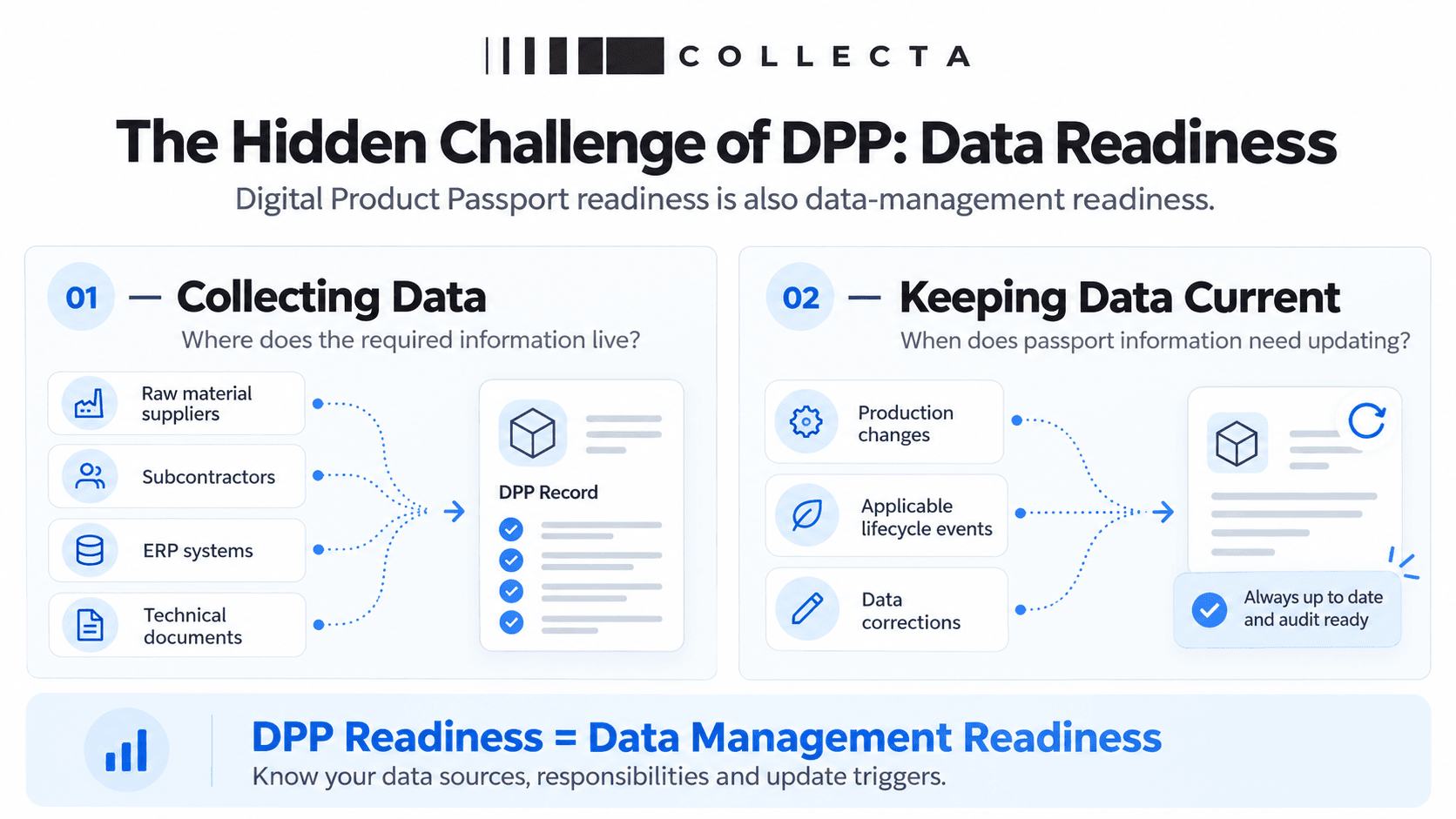
One of the most significant challenges in preparing for Digital Product Passports is not necessarily understanding what a QR code does.
It is understanding where the required product information will come from, who controls it, and how it will remain accurate over time.
In Collecta's conversations with companies preparing for Battery Passport requirements, two recurring uncertainties stand out.
Challenge 1: Collecting information companies have never needed to request before
Many businesses already maintain technical documentation, manufacturing records and product data.
However, upcoming passport requirements may introduce information needs that go beyond existing internal processes.
Some information may be held by raw material suppliers, subcontractors or other third parties.
Companies may not have previously needed to request this information in a structured and repeatable way.
This creates practical questions:
- Which supplier holds the required information?
- How should the company request it?
- Who is responsible for verifying the response?
- What happens when information is missing?
- How should supplier information be connected to the relevant product or model?
The challenge is not necessarily that the information does not exist.
The challenge is that the business may not yet have a process for collecting and managing it.
A DPP project can therefore reveal data-management dependencies that were previously outside the company's routine operations.
Challenge 2: Understanding when product data needs to be updated
A second uncertainty concerns the relationship between manufacturing, sales and ongoing passport maintenance.
Consider a company that manufactures a batch of products during one production period but distributes or sells them over the following twelve months.
The company may understand how to maintain its manufacturing records.
But a digital passport introduces additional questions:
Should the passport be updated every month? After every sale? Whenever a supplier changes? Only when specific information changes?
There is no single EU-wide monthly or annual update interval applicable to every Digital Product Passport.
Applicable legislation determines the required information, responsibilities and relevant update obligations.
For example, the ESPR requires passport information to be accurate, complete and up to date, while product-specific rules determine which actors can update which information.
For Battery Passports, requirements can include information that develops during an individual battery's lifecycle.
This makes it important to distinguish between:
- Static information: Data that remains valid unless the underlying product or documentation changes.
- Production-specific information: Data relating to a manufacturing batch or individual item.
- Lifecycle information: Applicable information that may change after production or market placement.
A new sale does not automatically mean every existing data field must be rewritten.
Likewise, the fact that manufacturing has finished does not mean the passport can necessarily remain unchanged for the rest of its existence.
The appropriate process depends on the legal requirements and the data involved.
The practical lesson: Build a data process, not just a passport page
These challenges point to an important operational consideration.
Digital Product Passport readiness is also data-management readiness.
Before selecting software, companies should understand what information they need, where it originates, how it is validated and what may trigger an update.
For businesses that have traditionally manufactured products in batches and sold them over extended periods, this can require a different approach to product information management.
Instead of treating information as a document completed during production, they may need to manage it as a structured record with clearly defined responsibilities.
This observation reflects the practical questions raised in Collecta's customer conversations, rather than a quantified industry-wide survey.
How Can Companies Prepare for DPP Requirements?
Preparing for DPP does not necessarily require an immediate, large-scale IT transformation.
A structured assessment can be a more useful starting point.
1. Identify the applicable legislation
Determine which of your products are already subject to DPP requirements and which may be affected by future rules.
Distinguish confirmed obligations from indicative regulatory plans.
2. Create a product data inventory
Identify the information your business already maintains and where it is stored.
This may include ERP systems, spreadsheets, technical documentation, manufacturing systems and supplier records.
3. Map supplier dependencies
Identify which information is held by external suppliers or subcontractors.
Define who will request it, review it and maintain the relationship with the data provider.
4. Define data ownership and update triggers
For each required information field, establish:
- Who provides the data?
- Who validates it?
- Who is responsible for updating it?
- Which changes should trigger a review or update?
- Which passport or product records may be affected?
Regular internal reviews may support good governance, but they should not be confused with a universally prescribed legal update frequency.
5. Start with one representative product
Choose one product model and test the complete information process.
Identify missing data, supplier dependencies, access requirements and potential lifecycle changes.
A focused pilot can make broader implementation decisions more informed and manageable.
Preparing for the EU Digital Product Passport?
Digital Product Passports introduce new expectations for how businesses collect, structure, share and maintain product information.
For many companies, the first challenge is not generating a QR code.
It is connecting information across internal systems, suppliers and the product lifecycle.
Collecta DPP helps businesses structure battery information, collaborate on required data and manage digital Battery Passports.
For battery manufacturers and importers preparing for the February 2027 requirements, establishing a reliable data-management process is an important first step.
Explore Collecta DPP for Batteries → https://www.collectadpp.com/
Official Sources and Further Reading
- European Commission — Digital Product Passport — Framework, regulatory timeline and Registry information.
- Regulation (EU) 2024/1781 — Ecodesign for Sustainable Products Regulation — Especially Articles 9–12 and Annex III.
- Regulation (EU) 2023/1542 — Batteries and Waste Batteries — Especially Articles 77–78 and Annex XIII.
- European Commission — Digital Product Passport FAQs — Product scope, the ESPR Working Plan and applicable timelines.
- European Commission — DPP Registry Launch — 20 July 2026 announcement.
- Collecta — What Is a Battery Passport? — Detailed Battery Passport guidance.
Disclaimer: This guide provides general regulatory information and does not constitute legal advice. Product-specific obligations must be assessed against applicable legislation and official guidance.
Frequently asked
Is the Digital Product Passport mandatory in the EU?
DPP requirements are becoming mandatory for selected products under applicable EU legislation. The ESPR does not impose an immediate, universal DPP requirement on every product. Specific obligations depend on the relevant product rules.
Does every product need a DPP by 2027?
No. Relevant EV, LMT and industrial batteries greater than 2 kWh have a confirmed Battery Passport application date of 18 February 2027. Other product groups follow different regulatory timelines.
Is a Digital Product Passport just a QR code?
No. A QR code can provide access to a DPP, but the passport is the structured digital information and supporting infrastructure behind that access point.
Can a Digital Product Passport contain restricted information?
Yes. Applicable product-specific legislation can establish different access rights for consumers, authorities and other stakeholders. Not every data field must be publicly accessible.
How often must a Digital Product Passport be updated?
There is no universal monthly or annual update interval for all DPPs. The applicable legislation determines relevant obligations. Companies should identify which information must remain current, which events may require updates and who is responsible.
Do companies need information from suppliers?
They may. Required information can originate from suppliers, subcontractors or other third parties. Companies should identify these dependencies early and establish appropriate collection and validation processes.
Can non-EU manufacturers be affected?
Yes. Products manufactured outside the EU may still be subject to DPP requirements when placed on the EU market, depending on the applicable product legislation and commercial arrangements.