A practical compliance guide for battery manufacturers, importers and companies placing batteries on the EU market.
However, identifying the right battery category is only the first step. Companies must also determine which economic operator is responsible, what information needs to be collected, and how the passport will remain accessible and accurate throughout the battery's lifecycle.
This guide explains the legal scope, responsibilities and practical preparation steps.
What Is the EU Battery Passport?
The EU Battery Passport is a structured digital record linked to an individual battery. It combines information about the battery model with information specific to that battery, including relevant data arising during its use. It is accessible through a QR code and must follow requirements for interoperability, data accuracy and controlled access.
The legal foundation is Article 77 of Regulation (EU) 2023/1542, supported by the technical requirements in Article 78 and the information requirements in Annex XIII.
A Battery Passport is not simply a PDF, a QR code or a product information webpage.
The QR code provides access to the digital record. The passport itself is the information infrastructure behind that access point.
For companies, this creates several operational requirements:
- Assign a unique identifier to each relevant battery.
- Collect and structure the required information.
- Make information available according to applicable access rights.
- Maintain accurate and up-to-date passport information.
- Ensure the passport remains available throughout the legally relevant battery lifecycle.
The challenge, therefore, is not only creating a digital record. It is establishing a process capable of maintaining that record over time.
Which Batteries Require a Passport from 18 February 2027?
Under Article 77(1), the Battery Passport requirement applies to three categories of batteries placed on the EU market or put into service from 18 February 2027.
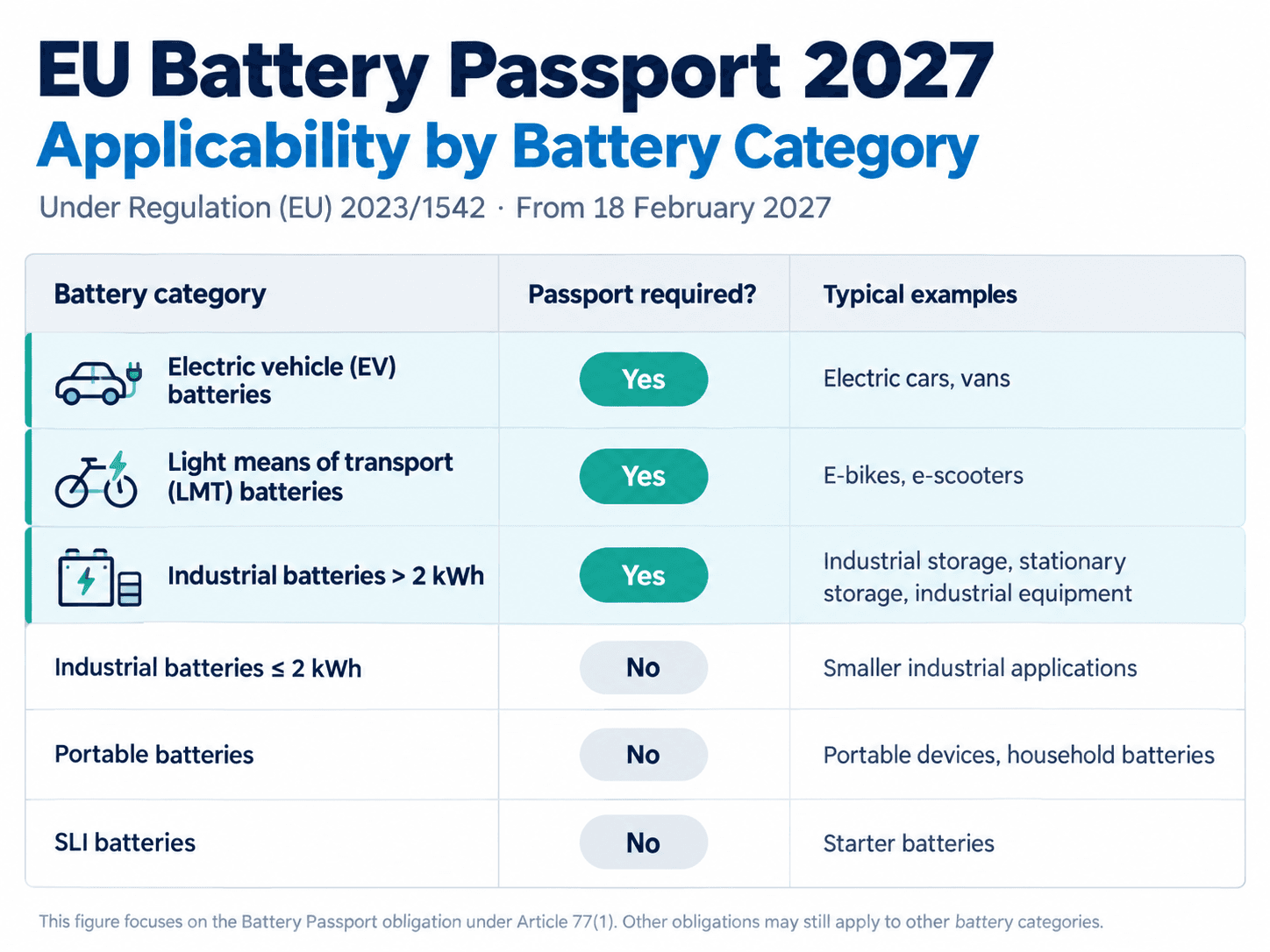
Battery Passport Scope Matrix
| Battery category | Battery Passport required? | Typical applications |
|---|---|---|
| Electric vehicle (EV) batteries | Yes | Electric cars, vans and other qualifying electric vehicles |
| Light means of transport (LMT) batteries | Yes | Qualifying e-bikes, e-scooters and other light electric vehicles |
| Industrial batteries greater than 2 kWh | Yes | Industrial energy storage, qualifying stationary storage systems and industrial equipment |
| Industrial batteries of 2 kWh or less | Not under Article 77(1) solely by virtue of being industrial batteries | Smaller industrial applications |
| Portable batteries | Not under Article 77(1) as portable batteries | Common household and portable-device batteries |
| Starting, lighting and ignition (SLI) batteries | Not under Article 77(1) as SLI batteries | Conventional vehicle starter batteries |
The table concerns the Battery Passport obligation specifically. Other requirements under the EU Batteries Regulation may still apply.
Electric vehicle batteries
EV batteries are within scope regardless of whether they exceed the 2 kWh threshold used for industrial batteries.
The regulation defines EV batteries according to their intended traction function and the relevant vehicle categories. Businesses should therefore classify the battery using the legal definition rather than relying only on its capacity or commercial product description.
Light means of transport batteries
LMT batteries include qualifying batteries designed for traction in light electric vehicles, such as many e-bikes and electric scooters.
Under the regulation, an LMT battery is a sealed battery weighing 25 kg or less and specifically designed for the traction of the relevant wheeled vehicles, provided it does not fall within the EV battery definition.
There is no general 2 kWh minimum for the LMT Battery Passport obligation.
This distinction matters for businesses selling relatively small mobility battery packs.
Industrial batteries greater than 2 kWh
Industrial batteries are covered when their capacity exceeds 2 kWh.
The industrial category includes various applications, potentially including stationary battery energy storage systems.
Importantly, stationary energy storage is not a fourth, independent Battery Passport category. A qualifying stationary system falls within the industrial battery category.
Companies should verify the actual battery classification and capacity rather than assuming that every energy-storage product is automatically covered.
Who Is Legally Responsible for the Battery Passport?
The primary responsibility lies with the economic operator placing the relevant battery on the EU market.
Under Article 77(4), that operator must ensure that the information in the Battery Passport is accurate, complete and up to date.
This is a particularly important distinction for companies operating across multiple entities, countries and supplier relationships.
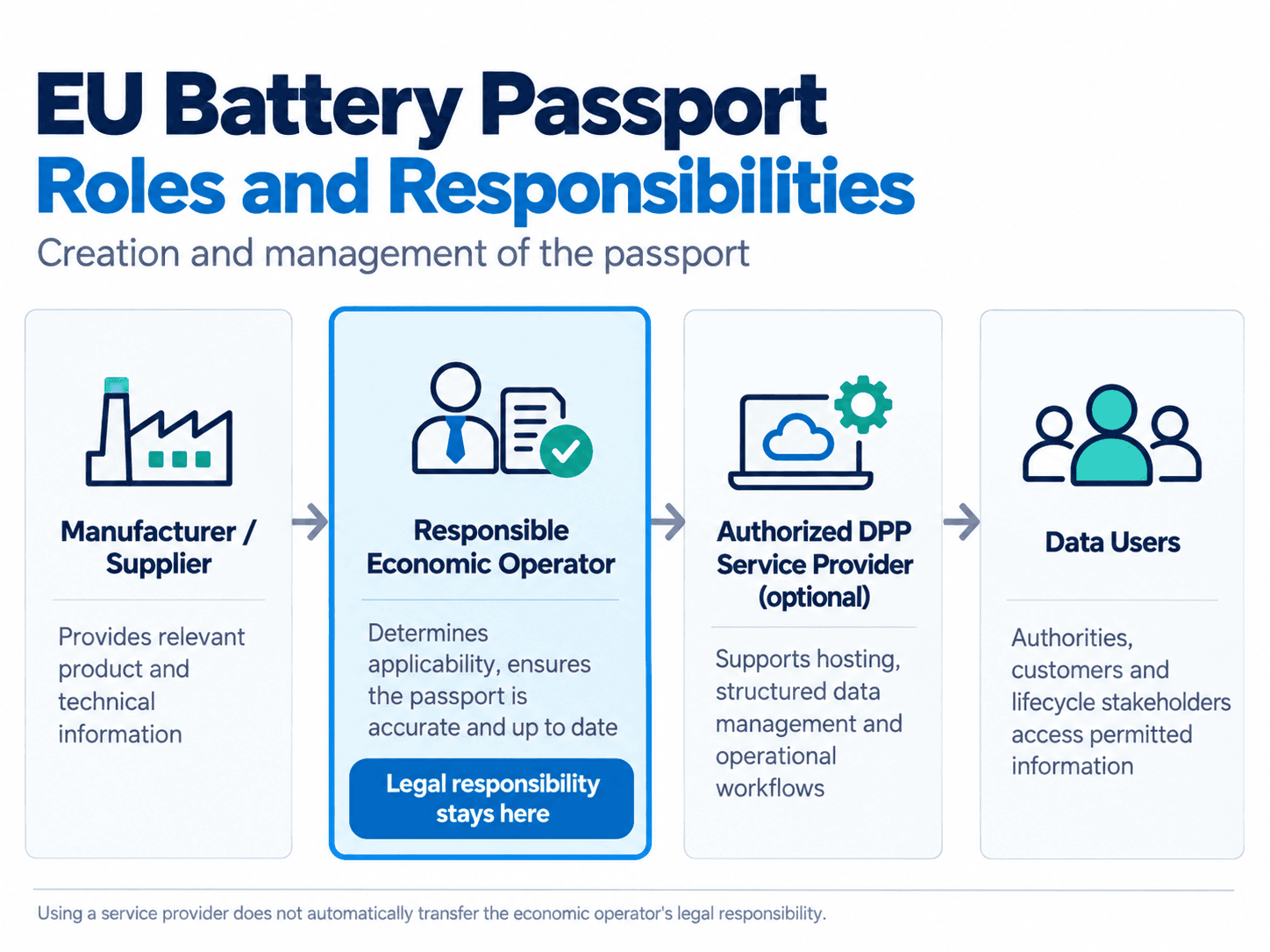
Scenario 1: A battery manufacturer based in the EU
An EU manufacturer placing its own finished batteries on the EU market will normally be the relevant economic operator.
Its operational tasks may include coordinating battery model information, collecting supplier data, generating individual battery records and maintaining those records after the batteries enter service.
Scenario 2: A battery manufacturer based outside the EU
Manufacturing outside the EU does not, by itself, determine whether the Battery Passport requirement applies.
For example, a battery manufactured in Türkiye and subsequently placed on the EU market may fall within the scope of Article 77.
The company responsible for the passport must be determined according to the actual market-placement arrangement.
Where an EU importer places the finished battery on the EU market, that importer will commonly be the responsible economic operator. Other commercial arrangements, including certain direct-sale situations, require their own assessment.
The important question is not simply:
“Who manufactured the battery?”
It is:
“Which legal entity is placing this finished battery on the EU market?”
Scenario 3: A company sourcing cells or components
A supplier providing cells, components or technical documentation to a battery-pack manufacturer does not automatically become responsible for the finished battery's passport.
Nevertheless, the supplier may hold essential data needed by the responsible economic operator.
This is why Battery Passport implementation frequently extends beyond one company's internal systems.
Scenario 4: A service provider manages the passport
Article 77(4) allows the responsible economic operator to give written authorisation to another operator to act on its behalf.
Article 78 also permits passport data to be stored by operators authorised to provide that service.
For example, a specialist software provider may support data management, passport hosting and relevant technical workflows.
Using a service provider does not automatically transfer the economic operator's legal responsibility.
Responsibility Flow
Battery manufacturer / supplier
Provides relevant product and technical information
Responsible economic operator
Determines applicability, ensures accurate and up-to-date information, and remains accountable for the passport obligation
Authorised DPP service provider (optional)
Supports hosting, structured data management, access and operational workflows within the scope of its authorisation
Battery Passport users
Access the information they are entitled to see, including relevant public authorities, purchasers and lifecycle stakeholders
This illustrates a typical operating arrangement, not a mandatory corporate structure.
The critical implementation decision is to identify one accountable organisation while defining the responsibilities of supporting parties.
Does the Battery Passport Apply to Batteries Manufactured Outside the EU?
Yes, where the battery falls within a covered category and is placed on the EU market or put into service.
The Battery Passport obligation is linked to market placement and putting into service, not exclusively to the geographical location of manufacturing.
Consider a company manufacturing LMT battery packs outside the EU and supplying an EU distributor.
The relevant questions include:
- Does the finished battery meet the legal definition of an LMT battery?
- Which entity first places it on the EU market?
- Who is responsible for creating and maintaining its passport?
- Which information must be supplied by the non-EU manufacturer?
- Who will manage identifiers, passport access and lifecycle updates?
An exporter might not be the responsible EU economic operator in every arrangement, but it may still need to provide substantial information to enable its customer to meet the requirement.
For this reason, export-oriented manufacturers should treat Battery Passport readiness as both a regulatory and commercial supply-chain issue.
What Information Must an EU Battery Passport Contain?
The required information is defined principally by Annex XIII of Regulation (EU) 2023/1542.
The Battery Passport combines information relating to the battery model with information specific to the individual battery.
Battery model information
Depending on the applicable requirements, model information may include:
- Manufacturer and battery identification details.
- Battery chemistry and material composition.
- Rated capacity and relevant voltage characteristics.
- Applicable carbon footprint information.
- Recycled content and responsible sourcing information.
- Certain performance, durability and safety characteristics.
Not every data point has the same applicability or implementation date.
The European Commission's August 2026 guidance, Digital Batteries Passport – Data Points by Category, distinguishes data requirements according to battery category and indicates whether particular fields are mandatory, conditional, optional or not required to be completed at the initial application date.
Companies should use that guidance together with the binding regulation rather than treating a generic vendor checklist as the definitive legal data model.
Individual battery information
Individual-level information identifies the specific battery and includes applicable information associated with its use and condition.
Some data can be established when the battery is manufactured or placed on the market. Other information may become relevant as the battery moves through its lifecycle.
This makes the Battery Passport different from a one-time compliance document.
Businesses need to establish who will update information, which systems provide the underlying data, and how changes will be managed.
Is all Battery Passport information public?
No.
Article 77 and Annex XIII establish different information-access categories, including:
- Information available to the general public.
- Information accessible to specified authorities and notified bodies.
- Information accessible to persons with a legitimate interest, subject to applicable conditions.
A Battery Passport therefore requires more than a public-facing product page.
It also needs appropriate information access and governance mechanisms.
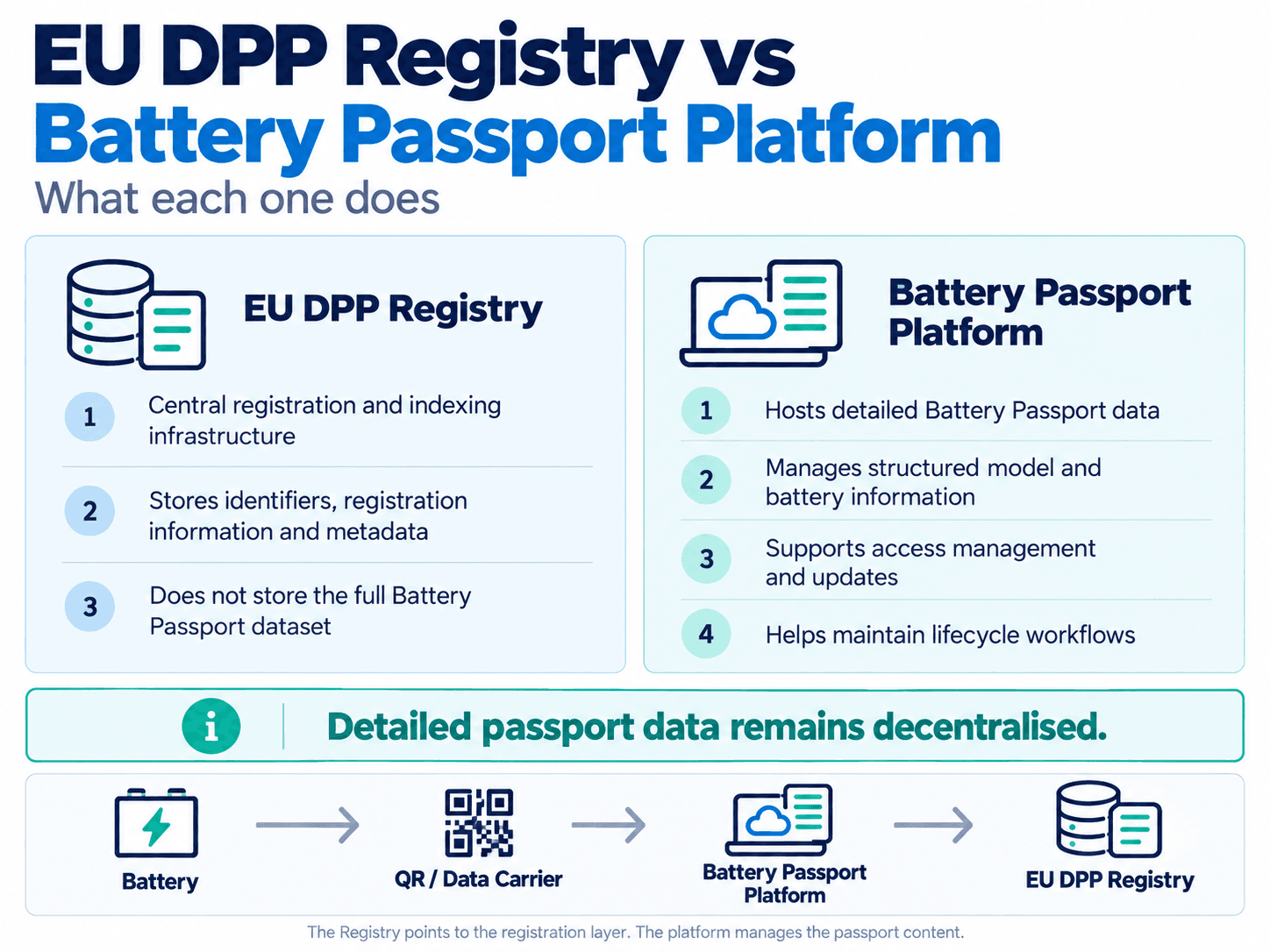
Is the EU DPP Registry the Same as a Battery Passport Platform?
No. The EU Digital Product Passport Registry and the platform hosting a Battery Passport perform different functions.
The Registry is the European Commission's central indexing and registration infrastructure. It stores identifiers, registration information and relevant metadata, rather than acting as the repository for the complete Battery Passport dataset.
The detailed passport information remains decentralised and is hosted by the responsible economic operator or an authorised service provider.
This distinction has important consequences for implementation.
The Registry does not replace a company's need to organise, host and maintain its passport data.
What is the Registry's current status?
The EU DPP Registry became operational on 20 July 2026.
However, an operational Registry does not necessarily mean that every product-specific registration workflow is available.
The Commission's September 2026 DPP Registry User Guide for Economic Operators states that successful Battery Passport registration was not yet available because the battery-specific semantic catalogue remained under development.
Companies can nevertheless prepare their economic-operator information, study the registration workflow and organise the data required for their passports.
Because the Registry and its product-specific specifications are evolving, businesses should verify the latest Commission documentation before attempting production registration.
How Should Battery Companies Prepare for February 2027?
A practical preparation programme does not need to begin with a large systems integration project.
It can begin with one representative battery model and a clear understanding of the organisation's data responsibilities.
Step 1: Confirm which batteries are in scope
Build an inventory of battery categories, models, capacities and intended EU market-placement arrangements.
Identify the products that fall within Article 77.
Do not assume that the full battery catalogue has identical obligations.
Step 2: Identify the responsible economic operator
Determine which legal entity is responsible for each relevant market-placement arrangement.
Where multiple companies are involved, document their respective responsibilities and information-sharing arrangements.
This should happen before decisions about software ownership or passport publication.
Step 3: Map the required information
Compare available product information against Annex XIII and the Commission's battery data-point guidance.
For every applicable data field, record:
- What information is required.
- Where that information currently exists.
- Which person or organisation owns it.
- Whether it is available and validated.
- Whether it must be updated after the passport is created.
This exercise exposes gaps before they become implementation delays.
Step 4: Establish supplier and lifecycle workflows
Not all relevant data will necessarily be held within the responsible company's ERP.
Some information may come from suppliers, manufacturing records, test results or other technical systems.
Define a practical process for collecting, reviewing and updating it.
Also determine which events will require passport changes and who will be authorised to make those changes.
Step 5: Select suitable passport infrastructure
Once the data and responsibilities are understood, evaluate the technical solution.
Relevant criteria include:
- Unique battery identifiers and QR-linked records.
- Structured model and individual-battery information.
- Access management for different stakeholders.
- Data imports and integration options.
- Update history and data integrity.
- Long-term hosting, continuity and portability.
- Support for applicable Registry workflows.
A suitable platform should support both initial preparation and ongoing passport operations.
The objective is not merely to publish thousands of QR codes. It is to maintain reliable, usable battery information across the product lifecycle.
Start with One Battery Model
For many companies, the most useful first step is not creating thousands of passports.
It is answering five practical questions for one real battery:
Is it covered? Who is responsible? Where is the required data? What is missing? How will the passport be maintained?
Once those answers are documented, businesses can move toward a repeatable process.
Collecta DPP is designed to help businesses organise battery passport data, create and manage digital records, collaborate on required information and prepare for ongoing passport operations.
Rather than treating the Battery Passport as a one-time document, Collecta approaches it as a structured information-management process.
Explore Collecta DPP → https://www.collectadpp.com/battery-passport
Official References
- Regulation (EU) 2023/1542 — Batteries and Waste Batteries, particularly Articles 3, 77 and 78, and Annex XIII.
- European Commission — Battery Passport Information and Implementation.
- European Commission — DPP Resources and Documentation, including Digital Batteries Passport – Data Points by Category and the DPP Registry User Guide for Economic Operators.
- Commission Implementing Regulation (EU) 2026/1778, establishing arrangements for the EU Digital Product Passport Registry.
- European Commission — Frequently Asked Questions on Digital Product Passports.
Disclaimer: This article provides general information about EU Battery Passport requirements and does not constitute legal advice. Applicability and responsibility should be assessed against the relevant legislation and each company's specific circumstances.
Frequently asked
Is the Battery Passport mandatory for every battery in 2027?
No. Article 77(1) covers EV batteries, LMT batteries and industrial batteries with a capacity greater than 2 kWh. Other battery categories remain subject to relevant provisions of the Batteries Regulation, but do not automatically require a Battery Passport under this article.
Do e-bike and electric scooter batteries need Battery Passports?
Qualifying LMT batteries do. The requirement depends on the battery's legal classification, including its intended traction function and the applicable LMT definition. Businesses should assess their specific battery products rather than relying only on the vehicle's commercial name.
Does a non-EU battery manufacturer need to prepare Battery Passport information?
Potentially, yes. A non-EU manufacturer supplying batteries destined for the EU may need to provide information to the responsible economic operator. The legal passport responsibility depends on the actual market-placement arrangement, not simply on where the battery was produced.
Can a company use an external Battery Passport provider?
Yes. The Batteries Regulation allows authorised operators to perform relevant activities on behalf of the responsible economic operator. Written authorisation and clear contractual responsibilities are important. The economic operator remains accountable for applicable legal obligations.
Is generating a QR code enough to meet the requirement?
No. The QR code is the access mechanism. The underlying passport must include the applicable information, follow the relevant technical requirements, respect information-access rights and remain accurate and available as required by law.
Does the Battery Passport need to remain available after the company closes?
Yes. Article 78(e) requires continued passport availability even if the responsible economic operator ceases to exist or stops operating in the Union. Article 77(8) provides that a Battery Passport ceases to exist after the battery has been recycled. This makes long-term service continuity an important infrastructure consideration.